Introduction
A bathroom scale can provide one simple number, but personal health and fitness progress rarely comes down to one number alone. Body weight can change from day to day because of hydration, meals, exercise, and other normal fluctuations. For people who want a broader picture of their measurements, a smart body composition scale can add additional information and make it easier to keep a record over time.
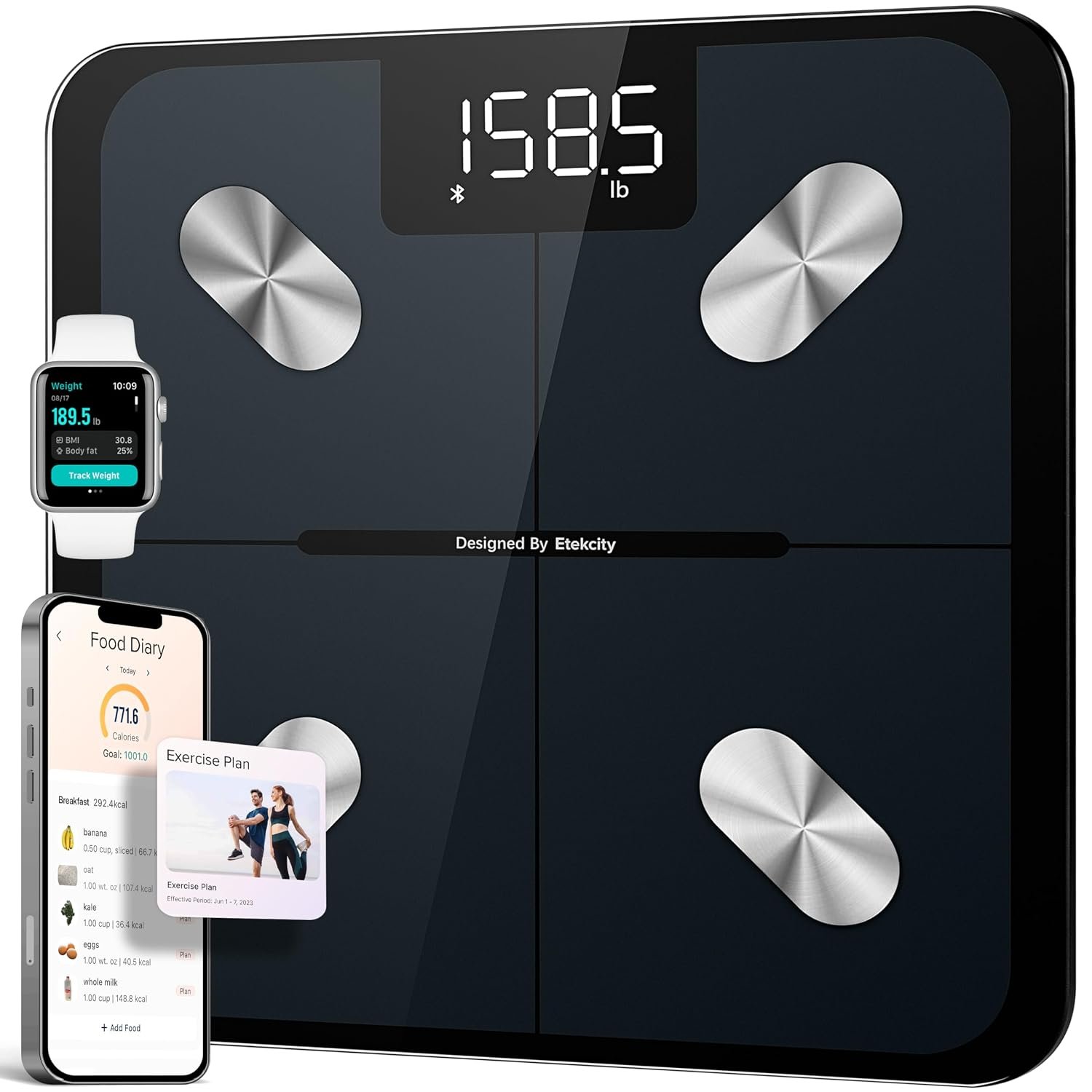
The Etekcity Smart Scale for Body Weight, Body Fat and BMI is designed to combine traditional weight measurement with app-connected body composition tracking. The model associated with the product listing is the Etekcity ESF-551, a Bluetooth-enabled smart scale with a tempered-glass platform, LED display, and support for the VeSync app. Product specifications list a maximum weight capacity of 400 pounds or 180 kilograms, with measurements in pounds, kilograms, or stones.
Beyond body weight, the scale is designed to provide measurements such as BMI, body fat, muscle mass, body water, bone mass, basal metabolic rate, and other body-composition metrics through its connected app. Etekcity describes the model as using bioelectrical impedance analysis, or BIA, to estimate these additional measurements.
That distinction is important. Weight is measured directly by the scale’s sensors, while many body-composition values are estimates produced using electrical measurements and user information. These estimates can be useful for observing trends, but they should not be treated as medical diagnoses or as replacements for professional testing.
The Etekcity Smart Scale is therefore best understood as a home tracking tool. It can help users establish a consistent weighing routine, record measurements, visualize changes, and integrate weight-related information with other fitness applications.
This guide explores how the scale works, its main features, possible uses, important considerations, general smart-scale categories, and practical ways to interpret the information it provides.
What Is the Etekcity Smart Scale?
The Etekcity Smart Scale is a digital bathroom scale designed to measure body weight and provide additional body-composition estimates through a connected smartphone application.
The ESF-551 model uses a tempered-glass platform and four high-precision sensors. Etekcity lists weight measurements in increments as small as 0.1 pound or 0.05 kilogram, with a maximum supported weight of 400 pounds or 180 kilograms.
The scale also connects to the VeSync application using Bluetooth. This creates a distinction between the physical scale and the broader tracking system.
The scale itself provides the immediate weighing experience, while the app can be used to store measurements, review historical information, view progress, and work with additional fitness-related data.
This can be useful because a single measurement has limited context.
For example, knowing that someone’s weight changed by a small amount between two days does not necessarily indicate a meaningful change in body composition. Looking at measurements across several weeks can provide a more useful picture of long-term trends.
Key Features
Digital Weight Measurement
The foundation of the Etekcity Smart Scale is still its ability to measure body weight.
The ESF-551 has four high-precision sensors and supports readings in pounds, kilograms, and stones. Its listed maximum capacity is 400 pounds, or 180 kilograms.
The scale is designed to provide readings in relatively small increments, which can make it useful for monitoring gradual changes.
However, a small displayed increment does not mean that every tiny change represents a meaningful physiological change.
Body weight naturally fluctuates throughout the day. Food, fluids, exercise, clothing, and other everyday factors can affect the number displayed.
For that reason, consistent measurement conditions are generally more useful than focusing on individual readings.
Body Mass Index
BMI, or body mass index, is another measurement supported by the scale.
BMI is calculated using body weight relative to height. It is commonly used as a broad population-level screening measure, but it does not directly measure body fat.
For example, people with substantial muscle mass can have a relatively high BMI without having a high level of body fat.
The Etekcity scale can therefore provide BMI as part of a larger collection of measurements rather than treating it as a complete description of an individual’s health.
This is an important distinction when interpreting the app’s information.
BMI can provide context, but it should be considered alongside other factors and, where appropriate, professional health guidance.
Body Fat Estimation
Body fat is one of the measurements that makes a smart scale different from a conventional digital bathroom scale.
The ESF-551 uses BIA technology. According to Etekcity, the scale uses electrodes on the platform to send a low-amplitude electrical current through the body and uses the resulting resistance measurement to estimate body-composition values.
BIA-based body-fat measurements are estimates rather than direct laboratory measurements.
Hydration, recent food intake, exercise, skin temperature, and measurement conditions can influence BIA results.
This means the most useful application is often tracking trends under consistent conditions rather than treating one individual percentage as an exact measurement.
For example, measuring around the same time of day and under similar circumstances can make comparisons more meaningful.
Muscle Mass and Other Body-Composition Metrics
The scale’s connected system can provide more information than body weight and BMI.
Etekcity lists measurements including:
- Body weight
- BMI
- Body fat
- Muscle mass
- Body water
- Bone mass
- Protein
- Visceral fat
- Subcutaneous fat
- Skeletal muscle
- Fat-free body weight
- Basal metabolic rate
- Metabolic age
These measurements are provided through the smart-scale system and app rather than representing thirteen independent direct measurements.
This distinction matters when reading the data.
A smart scale is collecting certain physical measurements and using algorithms and user information to estimate additional metrics.
The results can be useful for observing changes over time, but they should not be interpreted as equivalent to clinical laboratory testing or diagnostic examinations.
Bluetooth and the VeSync App
One of the defining features of a smart scale is the ability to connect measurements to a digital record.
The Etekcity ESF-551 works with the VeSync app through Bluetooth. Etekcity describes the app as a way to track measurements and view progress over time.
This can eliminate the need to manually write down every measurement.
Instead, users can build a historical record that makes it easier to see broader patterns.
For example, someone tracking their weight for several months may find that individual daily changes are less important than the overall direction of the data.
The app can also provide graphs and progress information, making numerical measurements easier to interpret visually.
Fitness App Integration
Smart-scale data becomes more useful when it can be incorporated into a broader fitness ecosystem.
Etekcity states that VeSync can connect with services including Apple Health, Google Fit, Fitbit, Samsung Health, and MyFitnessPal, depending on supported integrations and configurations.
This can help users avoid maintaining completely separate records.
For example, someone might already use a smartwatch or fitness application to monitor physical activity while using the Etekcity scale to record weight-related measurements.
Combining these data sources can create a broader personal tracking system.
However, users should review the privacy settings and permissions of each connected service before enabling data sharing.
Tempered Glass Platform
The scale uses a tempered-glass platform.
Tempered glass is commonly used in bathroom scales because it provides a smooth, easy-to-clean surface while maintaining a relatively slim profile.
The ESF-551 is listed with dimensions of approximately 11 by 11 by 1.1 inches.
A glass platform also makes placement important.
The scale should be positioned on a firm, level surface. Soft carpets or uneven flooring can affect the stability of a weighing scale and may lead to inconsistent readings.
The manufacturer also specifies anti-skid padding as part of the design.
Multiple User Profiles
A smart scale becomes more useful in a household when several people can use it without mixing their data.
The VeSync ecosystem supports multiple user profiles, allowing individual measurements to be associated with the appropriate account or profile. Etekcity describes its smart-scale platform as supporting multiple users.
This can make the scale suitable for shared household use.
Each person can establish their own tracking history instead of maintaining separate devices.
When multiple people use the same scale, however, it is important to make sure that measurements are assigned correctly.
Baby and Light-Item Modes
The ESF-551 is also described as supporting specialized weighing modes, including a mode for weighing babies and another for light items. Etekcity’s product information describes the scale as capable of weighing lighter objects and using a dedicated baby mode through its app.
A baby-weighing mode generally works by using an adult’s known weight as a reference and then calculating the difference when the adult holds the baby.
This can provide a convenient way to track changes at home.
It should not be interpreted as a substitute for professional infant weighing equipment when medical precision is required.
Similarly, a light-item mode can be useful for household objects, but the scale’s intended design remains centered around personal weighing.
How It Can Be Used
Establishing a Consistent Weighing Routine
One of the simplest ways to use a smart scale is to establish a regular measurement routine.
Rather than weighing at random times, a user might choose a consistent time of day.
For example, some people prefer measuring in the morning before breakfast. Others may choose another routine that fits their schedule.
Consistency can make measurements easier to compare because fewer variables are changing between readings.
The important point is not that one specific time is universally correct, but that the chosen routine is practical enough to maintain.
Tracking Long-Term Weight Trends
Daily body weight can fluctuate.
A person may weigh slightly more after a high-sodium meal or slightly less after exercise and fluid loss. These short-term changes do not necessarily represent corresponding changes in body fat.
This is where historical tracking becomes useful.
Instead of focusing on one day’s number, users can look at measurements across weeks or months.
A graph can make broader trends easier to see.
The smart scale’s app-based tracking is therefore potentially more useful than simply reading the number on the display and stepping off.
Supporting a Fitness Routine
Someone following an exercise routine may use the scale as one part of their overall tracking system.
For example, a person could combine:
- Body-weight measurements
- Exercise records
- Food tracking
- Activity data
- Sleep information
- Personal goals
The scale does not determine whether a fitness program is working by itself.
Instead, it can provide one source of information that can be considered alongside other indicators.
This is especially important for people participating in resistance training, because body weight alone may not reflect changes in muscle and fat.
Monitoring Body-Composition Trends
The additional BIA estimates can provide another perspective beyond weight.
For example, someone might observe that body weight remains relatively stable while estimated body-fat and muscle measurements change over time.
These measurements should still be interpreted cautiously because BIA estimates can vary.
The value comes primarily from observing trends under similar conditions.
A single unexpected reading is usually less informative than a consistent pattern across multiple measurements.
Family Use
A smart scale can also serve as a shared household device.
Parents, partners, or other household members can use separate profiles where supported.
This eliminates the need for multiple bathroom scales while keeping individual tracking information separate within the app.
For households with several users, it is worth establishing a simple routine so that each person’s measurements are recorded under the correct profile.
Who It May Be Suitable For
People Tracking Weight at Home
The scale can be useful for people who want a digital way to monitor their weight without manually recording each measurement.
The large display and smartphone connection provide two ways to access information.
Fitness Enthusiasts
People who already track workouts and nutrition may find additional body-composition estimates useful as another data point.
The scale can be integrated into a broader tracking routine through VeSync and supported fitness services.
People Interested in Trends Rather Than Single Readings
The app-based history can be particularly relevant to people who want to observe changes over weeks and months.
Rather than treating each measurement as an isolated result, users can look for broader patterns.
Families
Multiple-user support makes this type of smart scale practical for shared households.
Each person can maintain their own tracking information instead of relying on a single paper record.
People Building a Connected Fitness Setup
Someone already using Apple Health, Google Fit, Fitbit, Samsung Health, or another supported ecosystem may appreciate the ability to connect weight-related information with other activity data.
Important Things to Consider
Body-Composition Numbers Are Estimates
This is perhaps the most important consideration.
The scale directly measures weight, but BIA-based values such as body fat and muscle mass are calculated estimates.
They should not be treated as exact measurements of internal body composition.
Different devices can produce different estimates, and the same device can produce different readings depending on hydration and other conditions.
The best approach is to use the information as a trend indicator rather than a diagnostic measurement.
Hydration Can Affect BIA Measurements
BIA technology depends partly on how electrical signals move through the body.
Because hydration affects electrical conductivity, changes in hydration can influence estimated body-composition results.
Exercise, meals, alcohol, fluid intake, and other factors can also affect measurements.
For more consistent tracking, users should try to measure under similar conditions whenever possible.
Medical Conditions and Devices
BIA scales are not appropriate for everyone.
People who are pregnant or who have implanted electronic medical devices such as pacemakers should pay particular attention to the manufacturer’s safety guidance.
Etekcity provides a Zero-Current Mode on certain newer models to disable BIA, while the ESF-551 documentation should be consulted for the exact safety guidance applicable to this model.
Anyone with a medical condition, implanted device, or uncertainty about whether BIA is appropriate should consult a qualified healthcare professional before using the body-composition functions.
The scale should not be used as a diagnostic medical device.
Placement Matters
A bathroom scale should be placed on a hard, level, stable surface.
A carpeted floor can behave differently from tile, wood, or another hard surface.
Users should also avoid moving the scale repeatedly between measurements if consistency is important.
Keeping it in the same location can help establish a more repeatable measurement routine.
Foot Position Matters
BIA measurements depend on contact between the feet and the scale’s electrodes.
Standing differently from one measurement to another can potentially affect the results.
For consistent tracking, users should follow the manufacturer’s instructions regarding foot placement and measurement conditions.
Bluetooth and App Setup
The smart features require more setup than a basic bathroom scale.
Users need a compatible smartphone and the appropriate app.
Bluetooth permissions and application settings may also affect synchronization.
If the scale is used without the app, some functionality may be limited compared with the connected experience.
Before relying on app tracking, it is sensible to confirm that the scale is properly paired and that measurements are being recorded under the intended profile.
Understanding BMI
BMI is frequently displayed on smart scales, but understanding what it means is important.
BMI is calculated from weight and height.
It can be useful as a broad screening measure at a population level, but it does not directly measure:
- Body fat percentage
- Muscle mass
- Fat distribution
- Bone density
- Overall fitness
- Metabolic health
For example, an individual with significant muscle mass can have a higher BMI because muscle contributes to body weight.
The BMI number should therefore be interpreted in context.
The Etekcity scale can make BMI convenient to track, but it should not be treated as a complete health assessment.
Comparing General Scale Categories
Different bathroom scales serve different purposes.
| Scale Category | Weight Measurement | Body Composition | App Connectivity | Typical Purpose |
|---|---|---|---|---|
| Basic Digital Scale | Yes | No | No | Simple weight tracking |
| Bluetooth Smart Scale | Yes | Often | Yes | Weight and digital tracking |
| Body Composition Scale | Yes | Yes, estimated | Often | Broader personal tracking |
| Advanced Multi-Sensor Scale | Yes | More extensive | Often | Detailed body-composition estimates |
| Clinical/Professional Equipment | Yes | Depending on system | Varies | Professional assessment |
The Etekcity ESF-551 falls into the smart body-composition category.
Its main difference from a basic digital scale is not simply the display. It combines weight measurement with Bluetooth connectivity and app-based tracking, while also providing BIA-derived body-composition estimates.
Someone who only wants to know their body weight may not need those additional features.
Someone who wants historical records and additional estimates may find the connected approach more useful.
Smart Scale vs. Traditional Bathroom Scale
A traditional digital scale is straightforward.
Step on it, read the number, and step off.
There is little setup and generally no need for a smartphone.
A smart scale adds another layer.
It can record measurements automatically, create historical graphs, and provide additional information.
The trade-off is complexity.
Users who prefer simple equipment may appreciate a conventional scale. Users who enjoy tracking data may prefer a connected model.
Neither approach is inherently necessary for everyone.
The important consideration is whether the additional information will actually be used.
Making Measurements More Consistent
Use a Similar Time of Day
Measurements taken at different times can naturally vary.
Using a similar time each day can reduce some of the variation.
Use Similar Clothing Conditions
Clothing contributes to body weight.
If accurate trend comparison matters, measuring under similar clothing conditions can make the data easier to interpret.
Avoid Comparing Immediately After Exercise
Exercise can temporarily alter hydration and other physiological factors.
Because BIA measurements can be influenced by hydration, measurements taken immediately after exercise may not be directly comparable with measurements taken under resting conditions.
Keep the Scale in One Place
Moving the scale between different surfaces can introduce unnecessary variation.
A stable, permanent location can make the routine simpler.
Focus on Trends
A single reading can be misleading.
A longer record can show whether a change is persistent or simply part of normal daily fluctuation.
This is especially relevant to body-fat and other BIA-derived measurements.
FSA and HSA Eligibility
The product is marketed as FSA/HSA eligible.
However, eligibility and reimbursement rules can depend on the specific account, plan administrator, purchase documentation, and applicable tax rules.
A product being advertised as FSA or HSA eligible should not be interpreted as a guarantee that every individual’s account will reimburse the purchase.
Users who intend to use FSA or HSA funds should verify the current rules with their plan administrator or benefits provider before purchasing.
Keeping the receipt and relevant product documentation can also be useful for record-keeping.
Privacy and Health Data
Smart scales can create a significant amount of personal information when connected to an app.
Weight, body-composition estimates, goals, and related fitness information may be considered personal data.
Users should review the privacy policies and permissions associated with the VeSync app and any third-party services they connect.
Before enabling integrations with services such as Apple Health, Google Fit, Fitbit, Samsung Health, or MyFitnessPal, users should understand what information is being shared and where it may be stored.
Good digital-health habits include using a secure account password, keeping apps updated, and reviewing permissions periodically.
Frequently Asked Questions
What does the Etekcity Smart Scale measure?
The ESF-551 measures body weight and can provide additional body-composition estimates through its BIA technology and VeSync app. Listed metrics include BMI, body fat, muscle mass, body water, bone mass, protein, visceral fat, subcutaneous fat, skeletal muscle, fat-free body weight, BMR, and metabolic age.
What is the maximum weight capacity?
Etekcity lists the ESF-551 with a maximum capacity of 400 pounds, 180 kilograms, or 28 stone.
What measurements can it display?
The scale uses pounds, kilograms, or stones for weight measurements. The connected app provides additional body-composition information.
Does it connect to a smartphone?
Yes. The ESF-551 connects with the VeSync app through Bluetooth.
Does it measure body fat directly?
No. The body-fat figure is an estimate generated using BIA technology and other relevant information. It should not be treated as a direct laboratory measurement.
How accurate are body-fat measurements?
BIA measurements can vary based on hydration, exercise, food intake, foot placement, and other conditions. They are most useful for observing trends when measurements are taken under reasonably consistent conditions.
Can the scale calculate BMI?
Yes. BMI is one of the measurements provided through the smart-scale system.
Does BMI tell me how healthy I am?
No. BMI is a screening measure based on height and weight. It does not directly measure body fat, muscle distribution, fitness, or overall health.
Can several people use the same scale?
The VeSync ecosystem supports multiple users, making the scale suitable for shared household use.
Can it connect to fitness apps?
Etekcity states that VeSync supports integration with services including Apple Health, Google Fit, Fitbit, Samsung Health, and MyFitnessPal, subject to supported configurations.
Does it use batteries?
The ESF-551 uses three 1.5V AAA batteries, which are listed as included with the product.
Does it have a glass platform?
Yes. The scale uses a tempered-glass platform.
Can it weigh babies?
Etekcity describes a Baby Mode within its smart-scale ecosystem for tracking infant or child weight.
For medical or clinical monitoring, however, users should follow guidance from a pediatrician or healthcare professional.
Can it weigh small objects?
Etekcity’s product information describes a light-item weighing capability for items as light as approximately 100 grams.
Can pregnant people use the scale?
Pregnancy requires particular consideration because the body-composition function uses BIA. Users should follow the manufacturer’s safety instructions and consult a healthcare professional if they are uncertain about whether BIA is appropriate.
Can people with pacemakers use the body-composition feature?
People with implanted electronic medical devices should not assume that BIA is appropriate for them. Consult a healthcare professional and follow the manufacturer’s safety guidance before using the body-composition function.
Can the scale be used without the app?
The scale can provide basic weighing functionality, but smart features and historical tracking depend on the connected app experience.
Why do body-fat readings change from one day to another?
BIA estimates can be affected by hydration, exercise, meals, skin conditions, foot placement, and other factors.
Daily variation does not necessarily represent a real change in body fat.
Why can body weight change even when I have not gained fat?
Body weight naturally changes due to food, fluids, glycogen, digestion, exercise, and other normal factors.
A short-term increase or decrease should not automatically be interpreted as a corresponding change in body fat.
Should I weigh myself every day?
There is no universal requirement to weigh every day.
Some people prefer daily measurements because they provide more data for identifying trends, while others prefer weekly or less frequent measurements.
The most useful schedule is one that is consistent and does not create unnecessary stress.
Is the scale a medical device?
It should not be treated as a diagnostic medical device. Its body-composition measurements are estimates intended for personal tracking.
Anyone concerned about a health condition should consult a qualified healthcare professional rather than relying on smart-scale measurements.
Is the Etekcity Smart Scale FSA/HSA eligible?
The product is marketed as FSA/HSA eligible. Actual reimbursement depends on the user’s specific plan and applicable rules, so users should verify eligibility with their benefits administrator.
Conclusion
The Etekcity Smart Scale for Body Weight, Body Fat and BMI is designed to turn a basic bathroom weighing routine into a more connected system for personal tracking.
At its foundation, it provides digital weight measurement through four sensors, a tempered-glass platform, and a maximum capacity of 400 pounds or 180 kilograms. It then adds Bluetooth connectivity and the VeSync app, allowing users to store measurements, review trends, and access additional body-composition estimates.
The broader set of measurements can include BMI, body fat, muscle mass, body water, bone mass, visceral fat, skeletal muscle, BMR, and other estimates. These additional figures can provide context beyond the number shown on a traditional bathroom scale.
At the same time, it is important to understand what these numbers represent. Weight is measured by the scale, while many body-composition values are calculated estimates based on BIA and other information. Hydration, exercise, food intake, foot placement, and measurement conditions can influence the results.
For that reason, the scale is most useful as a tracking tool rather than a diagnostic instrument. Consistent measurement habits, stable placement, and attention to long-term trends can make the information more meaningful.
The Bluetooth and app functionality may be particularly useful for people who already track exercise, nutrition, or other wellness information digitally. Integration with supported fitness platforms can also reduce the need to manually transfer weight data between different services.
For households, multiple-user support provides another practical advantage, while features such as Baby Mode and light-item weighing can extend the scale’s usefulness beyond a single person’s daily measurements.
Ultimately, a smart scale is not a replacement for professional health assessment. It is a convenient way to collect and organize personal measurements at home. When used with realistic expectations, the Etekcity Smart Scale can serve as one component of a broader approach to monitoring weight and fitness-related trends.
Leave a Reply